Create an asset.
Start with your work, a moment, artwork or a file. Add the title and source in Bankeiz, then choose Create asset.
Your Original is sealed, already earning and kept in your account.One proof-native economy
Your Original is already earning.
Sign it to unlock its value.
The value is already there. Your signature unlocks its use.
Value accrues from the seal. Your signature unlocks what this Original has earned.Seal · Accrue · Sign · Unlock
ΦThe seal fixes the origin.
Your signature belongs to this Original.
Keep its proof and ownership with its value.
More than the material
Start with a breath. A moment you actually lived. Seal it as an Original. What you create with your moments—and how you connect them—is where a larger body of work, relationships and wealth can take shape.
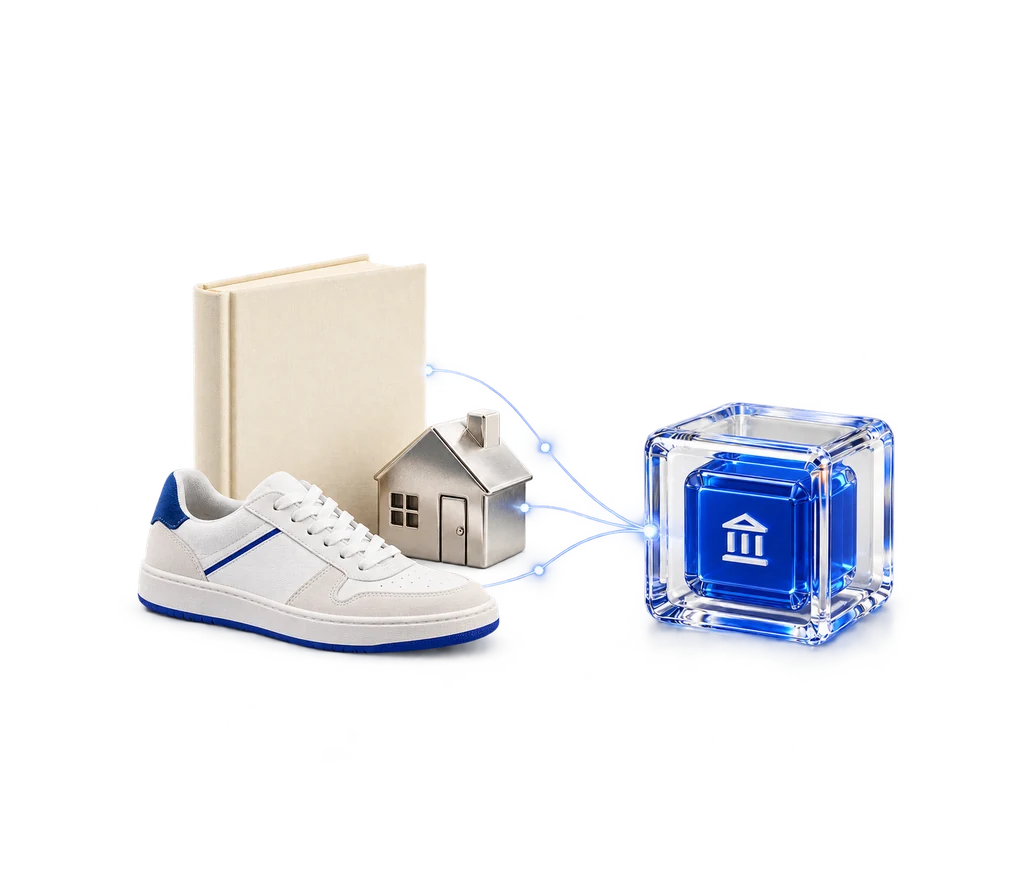
An early recording. A first edition. A piece of family history. The material is only part of what people value. Who made it, when it began and what happened to it matter. A proof object carries a sealed source and origin you can verify for yourself.
Your Original has intrinsic proof-native value under the published value law. Its verified source and sealed Kai origin supply the inputs. The same proof, evaluated at the same coordinate, produces the same value. You can open the file, check the source and reproduce the calculation.
The Original carries its committed content and origin. Its value history begins at that seal.
Verify the carried source. Evaluate its value at the later pulse using the same sealed origin.
A later copy carries the same Original. Reopening or copying the file preserves its origin and existing value history.
This Original’s PBI signature, public proof and current ownership govern access to its accrued value.
Illustrative coordinates: a seal at pulse 14,000,000, inspected at pulse 50,000,000. The original remains the source. Its later evaluation is a new calculation, with every input available to inspect.
Your Original is already earning
Create your asset. Sealing publishes it on Receiz and fixes the origin from which its value accrues. Choose Sign to unlock this Original’s accrued value for use.
Inside Bankeiz
Start with your work, a moment, artwork or a file. Add the title and source in Bankeiz, then choose Create asset.
Your Original is sealed, already earning and kept in your account.Choose Sign on your already public Original. Approve its PBI signature on your device to unlock its accrued value for use. Sealing publishes the Original on Receiz; Bankeiz Market listing is separate.
Your signature unlocks what this Original has earned.Your saved account opens first. If this device needs a new account, the existing account entry opens it and continues to Create an asset. Account access details ↗
Actual interface · Example Original. The walkthrough opens no account and performs no signing.
Actual Bankeiz screens · Example data. Approve PBI on your own device to unlock this Original’s accrued value.
Open your Originals in Receiz. Choose the signature icon labelled “Sign this original.” If the Original is hidden, use “Show on profile” to make it public. For a new public Original, choose Public and Seal Original. It is published when sealed. Sign that Original to unlock its accrued value. Signing the profile keyfile alone does not sign an Original.
Open your Receiz Originals ↗Each Original needs its own PBI signature to unlock its value. Signing another Original or your profile does not unlock this one. Its origin and value law stay intact.
Follow what the proof establishes
The seal binds the content and origin. Changing the content changes the evidence. Verification tests the carried proof before the value calculation runs.
The verified inputs and an explicit Kai coordinate produce the value. Replaying the same source at the same coordinate gives the same result, with each calculation step exposed.
Value moves through governed Settlement. The receiving implementation must preserve identity, ownership, exact value and continuous history. A copied image does not grant another person your spend authority.
Value accrues from the seal. Your signature unlocks what this Original has earned. Signing does not move the origin or restart the value law.
Value and the right to use it
The value law starts from the actual sealed origin. Later signing preserves that origin and the value history already accrued.
Your device requires you to approve the signing act through user verification. PBI binds that approval to this exact Original, your Receiz ID and its authorship history. Current ownership governs the authority to use it.
Use follows the existing Settlement rules. An accepted payment records the amount, participants and funding evidence. The recipient’s subsequent use continues through the same governed account and transfer rules.
It is the Original’s proof-native value, computed from its verified source under the published valuation law at an explicit Kai coordinate. The replay carries the inputs, policy and arithmetic so another verifier can reproduce the result. Phi units and their supported dollar display remain inspectable.
Material value describes the underlying material. A market price describes what a buyer and seller agree to exchange. The Original’s intrinsic calculation describes its value under the proof-native law. A completed sale records its own proceeds, and an accepted Settlement records its own funded transfer. Each has its own evidence.
The Original already has its sealed origin and accrued value. Signing is the deliberate act of approving this Original. The supported ceremony requires user verification; on a Face ID or Touch ID path, you approve that act on your device. PBI retains the verified result bound to this exact source and its causal history.
That history names the predecessor, your Receiz ID, the next signing position and its Kai coordinate. A verifier can check the approved act against that Original and its current ownership. This is the authority boundary that unlocks access to its accrued value. Claims made inside the content retain their own evidence.
Signing unlocks access under the existing value, ownership, issuance and Settlement rules. It preserves the sealed origin. A copied image, profile checkmark or signature from another Original cannot replace this Original’s own accepted proof.
The value you share has a source. Its admitted funding and transfer evidence keep that source connected as it moves. A recipient can inspect the source evidence carried by the payment and understand the history behind what they receive.
Imagine an Original supporting an accepted payment, then that recipient making another payment. Each governed transfer preserves its own amount and source relationship. The next recipient can follow the evidence the proof carries. This is an illustration of continuity, rather than a record of completed trades.
The public work and provenance associated with you can become part of the reputation you build. Before agreeing to a trade, someone can consider the carried source and decide what work they want to support. The proof supplies evidence; people make their own judgments.
Inspection follows the actual carried and public source, with its existing access permissions. Private signing keys and unrelated private account records remain outside that public evidence. Inspect transaction records or follow how a payment is recorded.
The Original carries its source, origin and accepted history, including the evidence of value already used. Transferring it preserves the remaining value and the same continuing accrual under its new owner. Sending money moves a recorded amount while the Original keeps its existing ownership.
The proof carries the truth. A database record or an older copy cannot erase prior consumption or restore spent value.
See the growth and spending arithmetic, including why repeated money payments and repeated Original transfers have different effects.
Whether you use dollars, gold, Bitcoin or proof-native value, ask the same practical questions: what do I hold, who controls it, what rules govern it, how can it move, and what can the next person do with it?
For this Original, inspect the source and origin. Reproduce its value. Verify the signing and ownership evidence. For a payment, inspect the accepted transfer and its funding. For a purchase, inspect the agreed terms, completed payment and delivery. Those are concrete things to check, rather than a familiar name to rely on.
The useful economic circle is people exchanging what they already produce and accepting value they can use onward. Follow that exchange circle, inspect public transaction records, or test the actual proof below.
Open the evidence
This is an existing public sealed essay, with its complete carried text and proof. Open the exact file, verify it on this device and inspect the value calculation. Then change one character and watch the proof check reject the altered source.
An actual sealed source
17,952 characters carried inside the original PNG. The verifier reads the sealed content and reproduces its value.
A historical proof/value example. It is unsigned, so its accrued value is not unlocked for use.
Keep the complete proof object ↓“THEY HAVE NO MACHINE. THEY HAVE NO ANSWER.”
Sealed Kai pulse: 14,611,069.
Exact artifact SHA-256:7dea328ef9accb1322853b868ec0fbd9a46f644cffbd377763eb08af7fe6784e
This unsigned historical sample demonstrates source verification and valuation. Its accrued value can be computed, but it is not unlocked for use.
No account required. Verification and calculation run locally.
Change one character of the carried essay in a separate copy. Its PNG checksum is repaired, so this tests the proof’s content binding.
Evidence before access
The enclosing artifact must verify. A correct PNG checksum alone cannot repair a broken source binding.
PBI verification binds the assertion to the exact Original and authorship history. Another object’s signature cannot stand in for yours.
Copies do not create additional value or another unlock. Existing value accounting retains its once-only source rules.
Authorship and current ownership are checked against carried evidence. Placement on a profile alone does not establish ownership.
The verified proof supplies the inputs. The published law computes the value at an explicit Kai coordinate. Anyone can reproduce the same calculation and inspect every step in the replay.
The supported PBI ceremony requires user verification through the authenticator. On a Face ID or Touch ID path, the person approves that signing act. The Original carries its verified result together with the exact source and ownership evidence.
A scoped signing append names the predecessor artifact, prior proof head, signer’s Receiz ID, next authorship position and exact Kai coordinate. The accepted history checks that sequence, preserves the predecessor and rejects a repeated predecessor or non-advancing Kai coordinate. Each accepted step occupies its own place in the Original’s continuous history.
One signing event cannot stand for another Original or another position in its chain. A copied image, signature badge or detached assertion cannot replace the complete proof. Concurrent conflicting descendants remain conflicts until an authorized successor resolves them; they do not become one accepted history by overwriting each other.
Your Original is already earning from its sealed origin. Its own PBI signature, public proof and current ownership unlock access to that accrued value. Each Original needs its own signature; signing one does not unlock another. The origin, valuation formula and governed Settlement rules stay intact.
Accepted proof remains in the Original’s history. A temporary source outage does not erase it. A profile signature, unsigned public object or display badge cannot replace this Original’s own proof.
Reality-grade banking
See where your money came from, who owns it and what happened along the way. That is the proof its Original carries, together with its exact value. Share a completed Note directly, including person-to-person delivery offline.
The proof is part of the money: it lets the next person verify what arrived and continue from its accepted history. Reality-grade banking implementations make handling it convenient. Use Bankeiz, reuse the open-source code or build your own experience. Receiving conformance means preserving the exact value, ownership and complete proof through the handover.
A deterministic valuation, an actual market sale and an accepted Settlement each establish a precise fact. Inspect the Original’s calculation, a sale’s completed payment and delivery, or Settlement’s exact funding and transfer evidence. That is how the history stays verifiable as value is used.