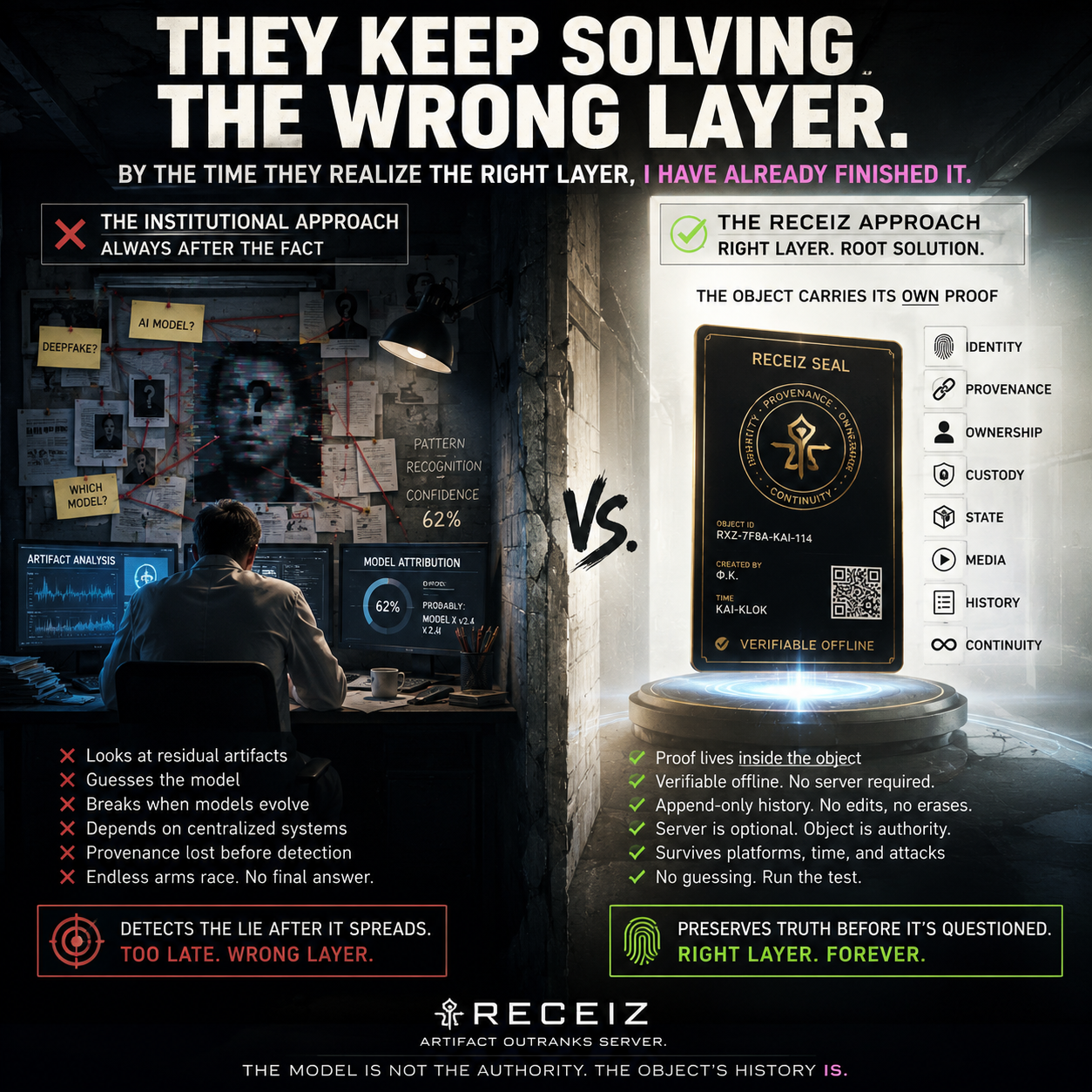
THEY KEEP SOLVING THE WRONG LAYER
Everyone is racing to identify which AI made the fake. Wrong layer. By the time you’re guessing, provenance is already gone. Receiz doesn’t detect history after the fact—it preserves identity, ownership, provenance, and continuity inside the object itself. Run the test. 🌬️🧾
Everyone is racing to identify which AI made the fake. Wrong layer. By the time you’re guessing, provenance is already gone. Receiz doesn’t detect history after the fact—it preserves identity, ownership, provenance, and continuity inside the object itself. Run the test. 🌬️🧾
Public Original
- Asset ID
- profile:bjklock:4a1b6bb3-ee72-4714-83f9-c29e58e6eb61
- Native asset ID
- 4a1b6bb3-ee72-4714-83f9-c29e58e6eb61
- Owner
- @bjklock
- Original Kai pulse
- 13377566
- Sealed at
- 2026-07-29T23:56:30.234348+00:00
- Observed USD value
- 11926.53
- Original digest
- 7021c2c5692be2836fcd0ce85d419eff7cc49a521c872874beaf425dc7db6995
Values are observations carried by the public source, not execution terms. Original evidence and material access keep their existing rules.
THEY KEEP SOLVING THE WRONG LAYER
THEY KEEP TRYING TO DETECT THE LIE AFTER IT HAS ALREADY SPREAD

Institutions are building increasingly sophisticated tools to guess which model generated a file. Receiz solved the actual problem: the object must carry its own identity, provenance, ownership, and continuity before anyone is forced to guess.

Every few weeks, another institution announces that researchers have built a new tool capable of detecting AI-generated media.

The headlines always sound revolutionary.

A system can identify whether a video is fake.

A classifier can determine which model generated an image.

Researchers can recognize subtle patterns left behind by a particular generator.

The institutions applaud because they believe they are getting closer to the answer.

They are not.

They are becoming more sophisticated at solving the wrong layer.

They are examining the residue left behind by the machine and attempting to reconstruct the origin after the object has already been detached from its source, copied across the internet, compressed, edited, reposted, screenshotted, and delivered to millions of people.

That is not provenance.

That is forensic speculation after provenance has already been lost.

They are building detectives.

I built the passport.

THE WRONG QUESTION

The institutional question is:

Which AI model probably made this?

The correct question is:

What is this object, who created it, what has happened to it, and can it prove that history for itself?

Those are not the same problem.

Knowing which model may have generated a video does not tell you:


who instructed the model,


who published the result,


whether the media was edited afterward,


whether the uploader owns it,


whether the file is the original,


whether its history has been altered,


whether the person depicted consented,


or whether the evidence you are examining is even the same object that first entered circulation.

Model attribution is not authorship.

Model attribution is not ownership.

Model attribution is not authenticity.

Model attribution is not provenance.

And it certainly is not truth.

A real video can be uploaded by a liar.

An AI-generated video can be clearly disclosed by its creator.

A legitimate production can contain synthetic elements.

A malicious edit can begin with authentic footage.

The model is not the authority.

The object’s verifiable history is what matters.

No one living through the consequences of synthetic media ultimately cares which version of which generator produced a particular cluster of pixels.

They care whether the object can prove where it came from.

THEIR SOLUTION EXPIRES AS SOON AS THE MODELS CHANGE

Detection systems are trained to recognize patterns.

Then the generators change.

The compression changes.

The editing pipeline changes.

The artifacts disappear.

The detector becomes less reliable.

The researchers retrain it.

The generators improve again.

The detector is updated again.

That is not infrastructure.

That is an endless institutional subscription to yesterday’s fingerprints.

They are attempting to establish truth by studying accidental imperfections left behind by a machine.

But accidental imperfections are not durable authority.

Once the generator learns not to leave those imperfections, the detector loses the thing it was trained to recognize.

So the entire industry becomes an arms race:

Generate.

Detect.

Evade.

Retrain.

Repeat.

More funding.

More papers.

More conferences.

More announcements.

Still no durable provenance.

They will spend billions teaching centralized systems to make increasingly confident guesses because the architecture never required the object to carry proof in the first place.

The failure begins before the detector ever sees the file.

THEY ARE STUDYING THE SMOKE BECAUSE THEY NEVER BUILT A FIRE RECORD

Imagine a warehouse with no inventory system, no serial numbers, no chain of custody, no signed transfers, and no permanent records.

Objects enter.

Objects leave.

Labels are removed.

Copies are made.

Years later, the institution hires researchers to examine scratches on the objects and guess which factory might have produced them.

That would be recognized immediately as absurd.

Yet this is the dominant institutional response to synthetic media.

They did not preserve continuity at creation.

They did not bind identity to the object.

They did not make provenance portable.

They did not make custody verifiable.

They did not allow the artifact to retain its own history.

Now they are studying visual scratches and calling it authentication.

It is not authentication.

It is archaeology performed on a system that chose not to preserve its own history.

THE SERVER CANNOT BE THE FINAL AUTHORITY

Even many supposed provenance systems repeat the same structural mistake.

They place the evidence in a platform, registry, database, or centralized service.

The file points back to the authority.

The authority does not travel with the file.

If the service disappears, changes its policy, revokes access, corrupts the record, loses the account, or becomes unreachable, the object loses the system that was supposed to explain it.

That is not sovereign provenance.

That is another dependency.

The object itself must carry enough proof to establish its identity and continuity independently.

The server may assist with synchronization, discovery, distribution, or convenience.

But the server cannot be the source of truth.

The artifact must outrank the server.

That is the layer Receiz was built to solve.

RECEIZ DOES NOT ASK THE PIXELS TO CONFESS

Receiz does not wait until an unknown file appears and then ask a classifier to guess what happened.

It gives the object a verifiable identity.

The object can carry:


its origin,


its creator,


its ownership,


its custody,


its media,


its state,


its transfers,


its append-only history,


and the proof required to verify its continuity.

That proof can travel with the object.

It can be verified offline.

It does not require somebody to trust the platform displaying it.

It does not depend on an institution recognizing the accidental fingerprint of a known model.

It does not ask the observer to believe the creator.

It makes the history testable.

The difference is fundamental.

Detection asks:

Does this resemble something artificial?

Receiz asks:

Does this object’s claimed history validate?

One is pattern recognition.

The other is proof.

EVEN PERFECT AI DETECTION WOULD NOT SOLVE THE PROBLEM

Suppose the institutions eventually build a detector with perfect model attribution.

It identifies the exact model, version, and generation pipeline every time.

The central problem would still remain.

Who generated it?

Under whose authority?

For what purpose?

Who modified it?

Who owns it?

Who published it?

Was it disclosed?

Was it authorized?

Was this the original output or a derivative?

What happened between creation and the moment it reached you?

A model label answers none of those questions.

They are building extraordinarily complicated machinery to identify the manufacturer of the pen while ignoring who wrote the letter, whether the signature is valid, and whether the document has been altered.

The model is merely a tool in the production chain.

The continuity of the object is the actual issue.

INSTITUTIONS KEEP ARRIVING AFTER THE DAMAGE

This is the recurring institutional pattern.

They allow architecture without continuity to become dominant.

They treat every file as a disposable representation.

They centralize identity inside accounts.

They centralize ownership inside databases.

They centralize provenance inside platforms.

They permit copying to destroy context.

Then, once the consequences become socially impossible to ignore, they establish a research initiative to detect the damage created by the original architecture.

They never question the layer.

They build another product on top of the failure.

A misinformation detector.

A deepfake detector.

A model-attribution detector.

A fact-checking layer.

A content moderation layer.

A trust score.

A centralized registry.

Each new layer exists because the object was never permitted to carry its own authoritative continuity.

They are trying to repair the internet without changing the assumption that broke it:

That the representation can be separated from its source and still somehow remain trustworthy.

It cannot.

Not without proof.

BY THE TIME THEY REACH THE RIGHT LAYER, I HAVE ALREADY FINISHED IT

Eventually, the institutions will arrive at the same conclusion.

They will stop asking how to detect synthetic residue and begin asking how an object can preserve identity, provenance, custody, ownership, and state across platforms and through time.

They will call it a new framework.

They will publish diagrams.

They will convene standards bodies.

They will create committees.

They will announce multiyear initiatives.

They will debate interoperability.

They will produce polished language describing “portable, cryptographically verifiable media provenance.”

And by the time they finally name the correct layer, Receiz will already have been operating there.

Not as a proposal.

Not as a research direction.

Not as a white paper.

As working architecture.

Objects already carry proof.

They already preserve continuity.

They already verify offline.

They already survive outside the platform that displayed them.

They already demonstrate that the server does not need to remain the authority.

The institutions are attempting to identify the machine that generated the representation.

Receiz establishes the identity and history of the object itself.

They are detecting yesterday’s fingerprints.

I am preserving continuity from the beginning.

They are trying to become better at guessing.

I removed the need to guess.

Run the test.

The artifact either carries valid proof or it does not.

Everything else is an opinion wrapped in a confidence score.
Carried text evidence
- Text SHA-256
- 34ab145ca6a866badc733a9f8b747fbca88566007a47064a54cf81b1f2a32229
Public proof manifest
- Coordinate
- 4BC1D316/13377566
- Pulse
- 13377566
- Verify Path
- /v/20260729_1956/4BC1D316/13377566?a=2ca26b7a&ms=1785369389795
- Circuit
- Groth16
- Groth16
- D953359B691E3225
- Poseidon
- 02ec7adafe30ad2e47b0fb65cd5bcba9d4f2ed9a719ddd365650af7ad9414b9a
- Claim SHA-256
- 4C3770E658ED3EDF3F8CE769CF22B22A16CC5C136B78C9CB6D465F8C70CEE93E
- Media SHA-256
- CF3565875DA24F2D8855C420906E666D91A0DE9AE8F91A34AD79955B17B32EAA
- PBI Signature
- DCA2A98EEAF9A6513C028D28A95721A9F692E4424694B640149AE0696CED2014
- Offline Verifier
- /offline-verifier.html
- Verification Key
- /zk/verification_key.json
Carried public pricing
{
  "quoteUsdPerPhi": 326.283435895,
  "priceUsd": 11926.53,
  "pricePhi": 36.55266,
  "intrinsicPhi": 36.55266,
  "changePct": 7.26,
  "volumeUsd": 38735.24,
  "liquidityUsd": 32043.47,
  "holders": 4,
  "premiumX": 1.073,
  "momentX": 1.042
}
Carried valuation inputs
{
  "kind": "sigil",
  "claimPulse": 13377566,
  "beat": 29,
  "stepIndex": 13,
  "creatorVerified": true,
  "frequencyHz": 436.212,
  "chakraDay": "Solar Plexus",
  "kaiSignature": "bjklock",
  "userPhiKey": "eecb99a0-9c6a-4e89-813b-f76331ea9c41:4a1b6bb3-ee72-4714-83f9-c29e58e6eb61"
}
Carried material details
{
  "kind": "image",
  "name": "17F72665-DC37-4EC7-844A-232F631828CB.png",
  "mime": "image/png",
  "size": 2164265,
  "sha256Hex": "cf3565875da24f2d8855c420906e666d91a0de9ae8f91a34ad79955b17b32eaa",
  "originalDownloadMime": "image/png",
  "originalDownloadName": "17F72665-DC37-4EC7-844A-232F631828CB.receized.png",
  "originalDownloadSize": 2166632,
  "originalDownloadSha256Hex": "7021c2c5692be2836fcd0ce85d419eff7cc49a521c872874beaf425dc7db6995",
  "originalDownloadPriceCents": 599,
  "originalDownloadLimit": 100,
  "allowOriginalDownload": true,
  "derivativeDownloadMime": "image/png",
  "derivativeDownloadName": "receiz_20260729_1956_4BC1D316_derivative.png",
  "allowDerivativeDownload": false,
  "allowMomentRecordDownload": false,
  "receiptTzMinutesEast": -240,
  "receiptMs": "1785369389795"
}