Receiz v96.0.0: Proof-Native Artifact System
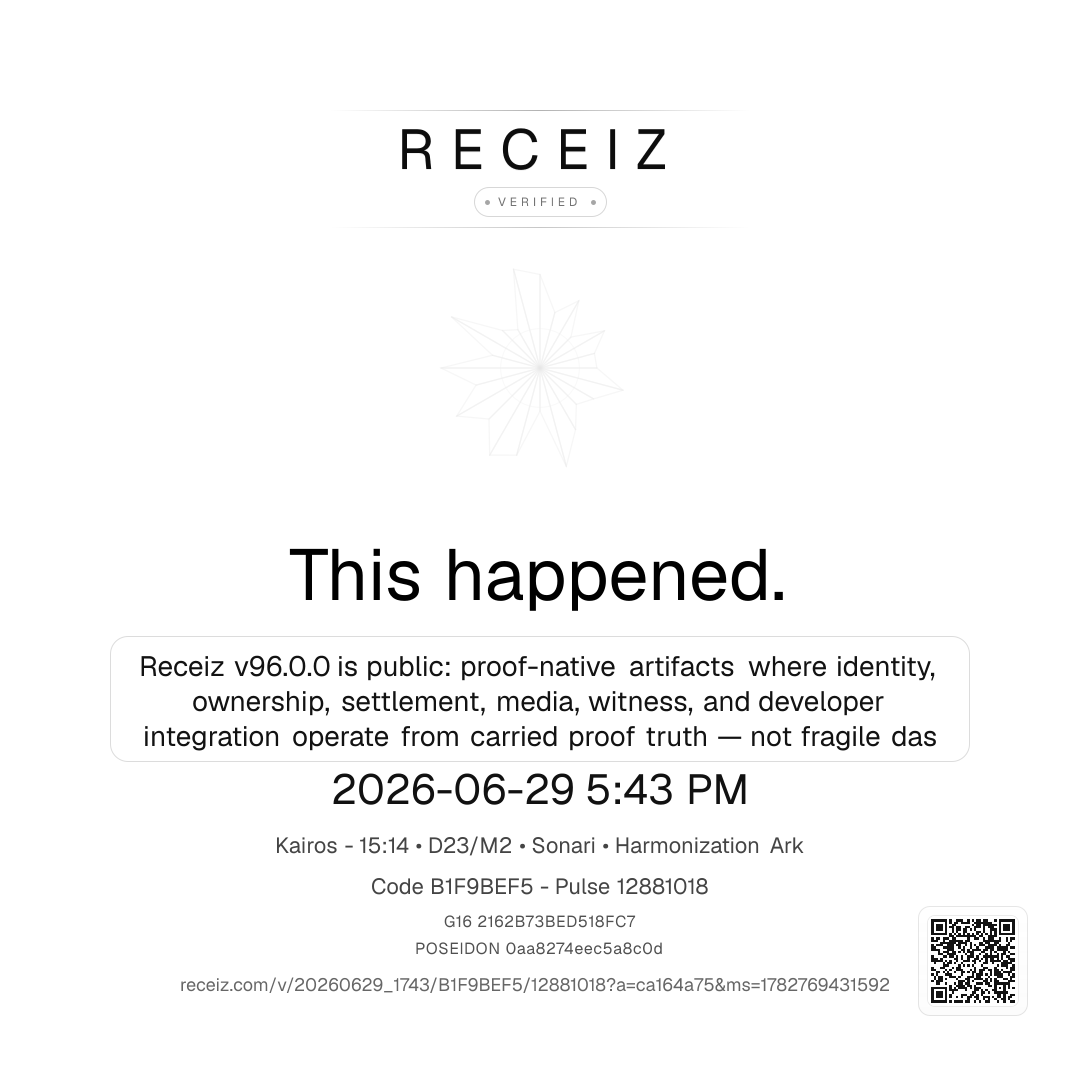
Receiz v96.0.0 is public: proof-native artifacts where identity, ownership, settlement, media, witness, and developer integration operate from carried proof truth — not fragile dashboards. Record. Seal. Verify. Append forever. Link https://github.com/kojibai/receiz_offline_verifier
Receiz v96.0.0 is public: proof-native artifacts where identity, ownership, settlement, media, witness, and developer integration operate from carried proof truth — not fragile dashboards. Record. Seal. Verify. Append forever. Link https://github.com/kojibai/receiz_offline_verifier
Public Original
- Asset ID
- profile:bjklock:35fbfeb0-19e6-46b0-987a-512e4d859b06
- Native asset ID
- 35fbfeb0-19e6-46b0-987a-512e4d859b06
- Owner
- @bjklock
- Original Kai pulse
- 12881018
- Sealed at
- 2026-06-29T21:43:51.805792+00:00
- Observed USD value
- 13563.31
- Original digest
- 56a5fd5fd72cacf256a70e7e5eede3ae29b82dbbf3f05416059853a137e783ff
Values are observations carried by the public source, not execution terms. Original evidence and material access keep their existing rules.
Receiz v96.0.0: Proof-Native Artifact System
Receiz v96.0.0: Proof-Native Artifact System

Receiz is not a generic app with proof features.

Receiz is a proof-native artifact system.

That distinction matters.

Most digital systems ask users to trust a platform. A server says what exists. A database says who owns it. A dashboard says what happened. A session says whether you can see it. If the platform loads slowly, fails, changes, disappears, or rewrites state, the user is left waiting for someone else’s system to remember.

Receiz starts from a different law:

Truth travels with the object.

A Receiz proof object carries deterministic identity, verifiable payload, provenance, inspection behavior, durable state, and Kai/Klok state. The object is not merely a file, listing, profile, card, receipt, or page. Those are projections. The proof object is the stronger primitive beneath them.

That means Receiz does not treat the database as the final source of truth. The database matters. Servers matter. APIs matter. SDKs matter. They sync, publish, index, repair, and distribute verified additions. But they do not outrank sealed proof truth.

The authority order is strict:

Receiz law and product invariants
→ sealed artifact truth and embedded proof
→ deterministic proof object state
→ verified local truth and durable proof memory
→ verified appends and register blocks
→ server, database, session, API, SDK, and CLI

A weaker layer may decorate, hydrate, index, sync, or publish stronger truth.

A weaker layer must never replace stronger truth.

That is why Receiz can behave differently from normal software. If a user already has a valid proof object, the product can project known truth immediately. A database timeout may delay global sync, but it must not make known proof disappear.

That is not fallback behavior.

That is the primitive.

Receiz follows the operating law:

Record. Seal. Verify. Append forever.

Known verified truth is used immediately. The system asks only what verified additions exist after the known proof/Kai head. Sealed proof truth remains true. New verified truth appends.

This is why Receiz feels fast. The fastest request is the one the system does not need to make. Once truth is verified and stored, Receiz does not need to rediscover it before using it. It starts from admitted truth, then syncs verified additions.

This also changes what a digital object can be.

A creator can seal an original work. Later sales, transfers, public witness, rights evidence, or disputes append to the same proof object. The work does not become a loose upload waiting for a platform to remember it.

A fan can own a sports card that carries athlete identity, ownership state, event proofs, score deltas, pitch witnesses, play witnesses, and durable card memory. When a live event happens, verified additions append to the card. Reopening the card projects admitted history first.

A business can accept payment into a proof-native settlement trail. The payment does not disappear into a generic balance. It becomes a record with value state, reserve, certificate or note context, payer/payee evidence, and proof-native completion. Receipts, refunds, transfers, audits, and reconciliation append beneath the same settlement primitive.

Same law in all three cases:

The object carries truth.
The app projects it.
Servers and databases publish, index, and sync additions beneath it.
Chronos helps humans read the moment.
Kai orders the proof state.

v96.0.0 also makes the developer surface public and executable.

Developers can install:

npm install @receiz/sdk

Then run local conformance, inspect proof payloads, generate a durable proof memory starter, verify packaged fixtures, use typed clients, validate schemas, project known truth, verify webhooks, integrate Sports card/event proof, read wallet state, and build with Connect.

The SDK is not a new authority.

It is a convenience layer beneath proof truth.

That is the security boundary.

The SDK exposes schemas, validators, projections, helper clients, CLI inspection, local conformance, and integration examples. It does not expose private signing authority, service-role access, production database authority, private production secrets, or a way to mint valid Receiz proof objects without required proof material.

Developers can build experiences for Receiz assets.

They cannot turn the SDK into Receiz authority.

That is the correct public architecture:

Open verification. Controlled authority. Public proof. Gated action. Durable memory. Append forever.

Receiz v96.0.0 is the public architecture report for that system.

It explains why Receiz matters to users, creators, developers, builders, institutions, governments, and partners.

For users, Receiz means stronger digital continuity. Identity, wallet history, cards, media, market state, and public proofs do not need to vanish because a session, server, or database is slow.

For creators and inventors, Receiz turns work into public proof objects with provenance, ownership/custody, inspection, verification, and durable witness surfaces.

For developers, Receiz provides an SDK and CLI so proof-native experiences can be built without reinventing authority, verification, durable memory, or append-sync law.

For institutions, Receiz provides inspectable, append-only records, offline verification, deterministic identity, settlement primitives, and auditability built into the object model itself.

This is the breakthrough:

Receiz does not only prove objects.

Receiz makes proof usable.

Immediate first paint.
Durable history.
Offline verification.
Public witness.
Ownership.
Settlement.
Identity continuity.
Developer integration.

One primitive law.

Record. Seal. Verify. Append forever.
Carried text evidence
- Text SHA-256
- a94206900cdb4c63aa95edd90a0f0aac834d73aaa27a0f56df9147802cb3d8db
Public proof manifest
- Coordinate
- B1F9BEF5/12881018
- Pulse
- 12881018
- Verify Path
- /v/20260629_1743/B1F9BEF5/12881018?a=ca164a75&ms=1782769431592
- Circuit
- Groth16
- Groth16
- 2162B73BED518FC7
- Poseidon
- 0aa8274eec5a8c0d2a682834c1fa87f92ad862e69229bcf35d5f813dd31e1e90
- Claim SHA-256
- E812F393156D95CE0E2616B8462C972508FC7050B36958A551F5785140D20242
- Media SHA-256
- 519F405A4933F22E75A34C85E7029E45B8D604C39CB31C3876D70F53D191E243
- PBI Signature
- 9147989720A1B77B1478150B83579BFB3143977BA149559BA158D65579FB8372
- Offline Verifier
- /offline-verifier.html
- Verification Key
- /zk/verification_key.json
Carried public pricing
{
  "quoteUsdPerPhi": 337.169649607,
  "priceUsd": 13563.31,
  "pricePhi": 40.226972,
  "intrinsicPhi": 40.226972,
  "changePct": 6.44,
  "volumeUsd": 53247.76,
  "liquidityUsd": 24967.51,
  "holders": 3,
  "premiumX": 1.064,
  "momentX": 0.969
}
Carried valuation inputs
{
  "kind": "sigil",
  "claimPulse": 12881018,
  "beat": 15,
  "stepIndex": 14,
  "creatorVerified": true,
  "frequencyHz": 1506.119,
  "chakraDay": "Throat",
  "kaiSignature": "bjklock",
  "userPhiKey": "eecb99a0-9c6a-4e89-813b-f76331ea9c41:35fbfeb0-19e6-46b0-987a-512e4d859b06"
}
Carried material details
{
  "kind": "pdf",
  "name": "receiz-v96-public-architecture-report.pdf",
  "mime": "application/pdf",
  "size": 58028,
  "sha256Hex": "519f405a4933f22e75a34c85e7029e45b8d604c39cb31c3876d70f53d191e243",
  "originalDownloadMime": "application/pdf",
  "originalDownloadName": "receiz-v96-public-architecture-report.receized.pdf",
  "originalDownloadSize": 60646,
  "originalDownloadSha256Hex": "56a5fd5fd72cacf256a70e7e5eede3ae29b82dbbf3f05416059853a137e783ff",
  "allowOriginalDownload": true,
  "derivativeDownloadMime": "image/png",
  "derivativeDownloadName": "receiz_20260629_1743_B1F9BEF5_derivative.png",
  "allowDerivativeDownload": false,
  "allowMomentRecordDownload": false,
  "receiptTzMinutesEast": -240,
  "receiptMs": "1782769431592"
}